About Ghalib University
A decade and a half of academic excellence, innovation, and nation-building
Our Mission
Ghalib University (Herat) serves the community by providing quality educational services with consideration of Islamic and national values, utilizing new technology, training specialized, professional and committed personnel, and conducting scientific research.
Our Vision
Ghalib University (Herat) aims to achieve a top position among the universities of the country within the next five years through teaching, research, promotion of knowledge, and providing committed and specialized workforce.
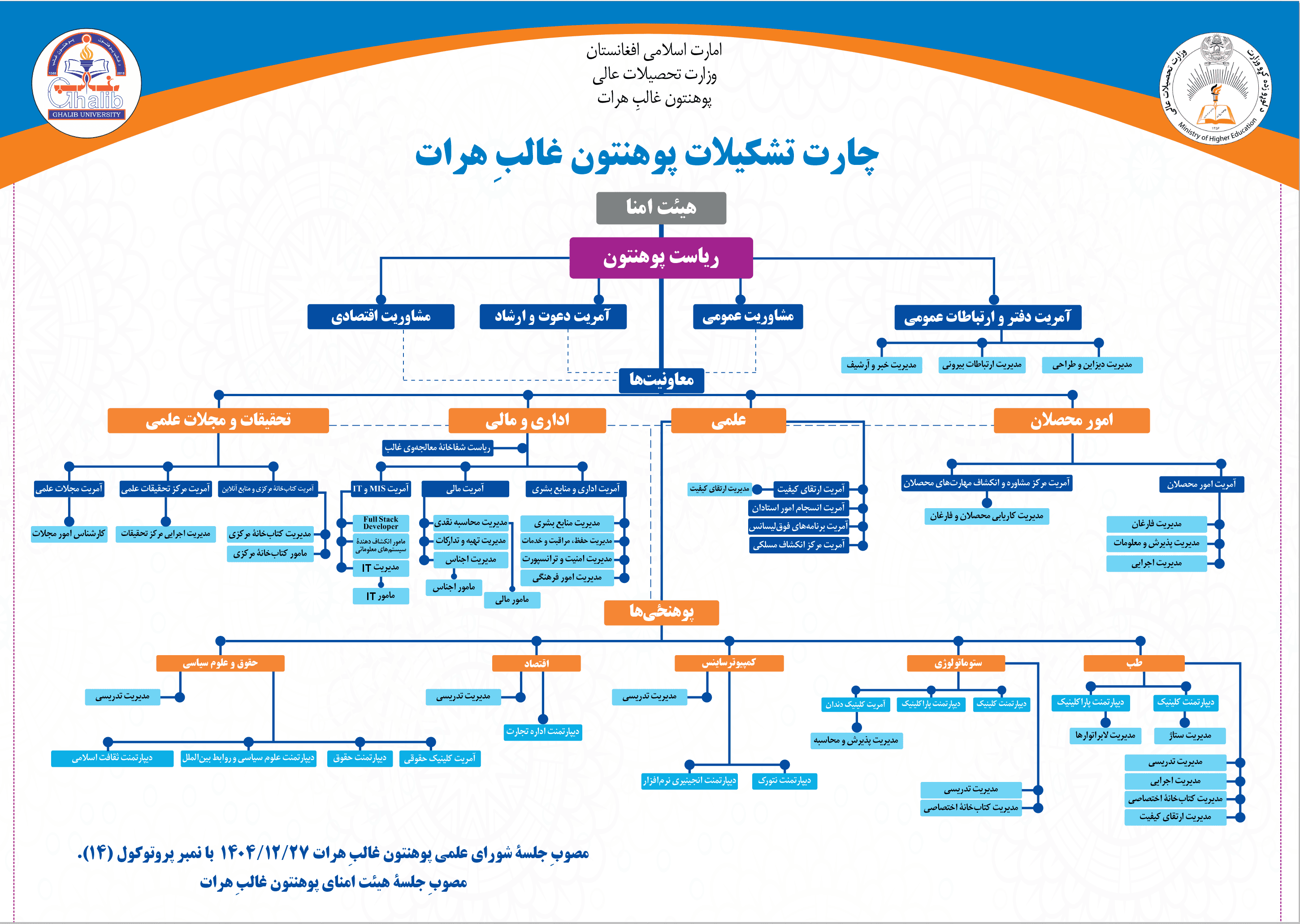
Our Organization Structure
Our Core Values
Integrity
We uphold the highest standards of honesty and ethical conduct in all our endeavors.
Excellence
We pursue outstanding quality in teaching, research, and community service.
Innovation
We foster creative thinking and embrace new ideas to solve real-world challenges.
Inclusion
We value diversity and create an environment where all voices are heard and respected.
1389 · 2010
Our History
Ghalib University Herat was established in 1389 (2010) after obtaining an official license from the Ministry of Higher Education of Afghanistan, and began its activities in three faculties (Medicine, Computer Science, and Law & Political Science) within the framework of private higher education institutions. In 1390 (2011), it succeeded in obtaining licenses for two additional faculties (Stomatology and Economics), and now has a total of 5 faculties and 7 departments.
• Ghalib University Herat has the Department of Medicine under the Faculty of Medicine, the Department of Dentistry under the Faculty of Stomatology, the Department of Business Administration under the Faculty of Economics, the Department of Law and the Department of Political Science/International Relations under the Faculty of Law & Political Science, and the Department of Software Engineering and the Department of Networking under the Faculty of Computer Science. • Ghalib University Herat presented its first graduating class from the Faculty of Law & Political Science in 1392 (2013), and this tradition continues. To date, more than 4,000 graduates in the fields of Law & Political Science, Computer Science, Economics, Medicine, and Dentistry have been presented to society, achieving success in the job market and reaching high positions. • Medicine graduates receive the MD degree, Dentistry graduates receive the DMD degree, and graduates of the other three faculties receive the Bachelor's degree from this institution. • In 1394 (2015), after review by the Ministry of Higher Education and meeting all requirements, Ghalib University Herat was upgraded from an institute to a university. • In 1396 (2017), Ghalib University Herat successfully passed the first phase of accreditation. • In 1397 (2018), Ghalib University Herat completed the second phase of accreditation. • In 1403 (2024), Ghalib University Herat completed the third phase of accreditation and received the Academic Accreditation Certificate. • In the 1403 (2024) evaluation by the Directorate of Supervision and Evaluation of Academic Affairs of the Ministry of Higher Education of Afghanistan, Ghalib University was officially recognized as one of the commendable educational institutions and one of the top six universities in Afghanistan. • The Scientific Research Center, Information Technology Department, Central Library and faculty libraries, 14 equipped laboratories, legal clinic, dental clinic, and modern educational facilities are among the most important facilities of this university.
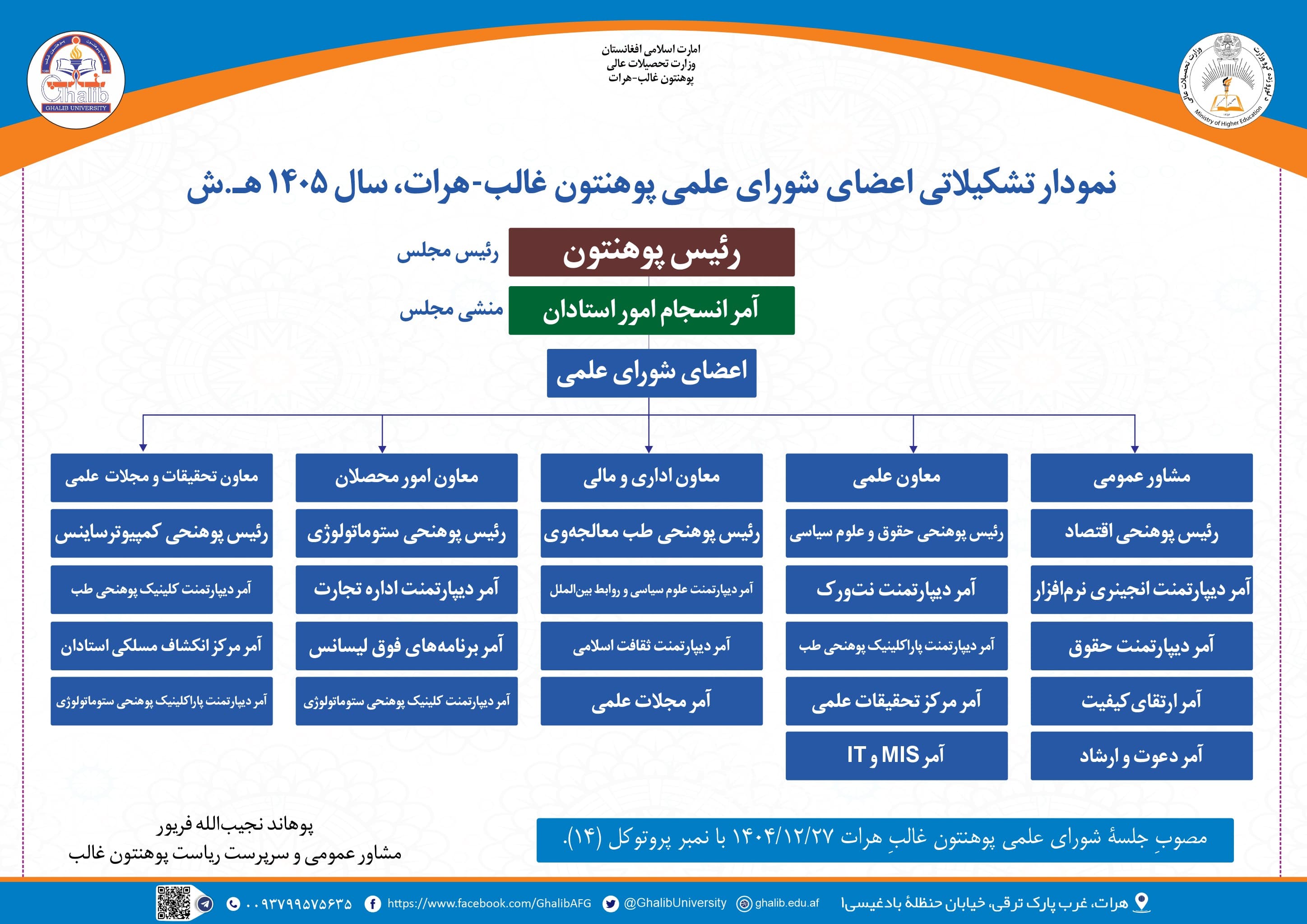
University Academic Council
Duties and Authorities of the University Academic Council
The Academic Council of the institution is the highest decision-making body for higher education, with the following duties and authorities:
Proposal by the head of the higher education institution regarding the appointment of deputies;
Formulation and arrangement of higher education and scientific research policies and submission to competent authorities;
Development and evaluation of curricula and academic-research programs;
Proposal of development plans;
Supervision of the implementation of educational plans and programs;
Study and proposal for the establishment, expansion, division, annexation, merger, or abolition of faculties and departments;
Proposal for signing, amending, extending, or terminating memorandums of understanding and commitment contracts;
Study and proposal for conducting postgraduate academic programs;
Decision-making on proposals regarding the appointment or dismissal of academic staff;
Evaluation of academic promotion, confirmation of academic ranks, and their approval;
Evaluation of academic activities of relevant faculties and reporting to the Ministry of Higher Education;
Evaluation of the activities of vice-chancellorships, publications departments, central library, information technology center, scientific research coordination center, master's and doctoral programs center of the higher education institution, quality improvement and finding ways for improvement;
Approval of honorary diplomas and their award if an active doctoral program exists;
Establishment of specialized committees and delegation of some authorities to them;
Proposal for drafting and amending bills and approval of relevant regulations;
Performance of other duties and authorities specified in relevant legislative documents.